



Pou li atik sa a an kreyòl ayisyen, klike la.
SPRINGFIELD, OHIO — The letters arrived with almost no warning.
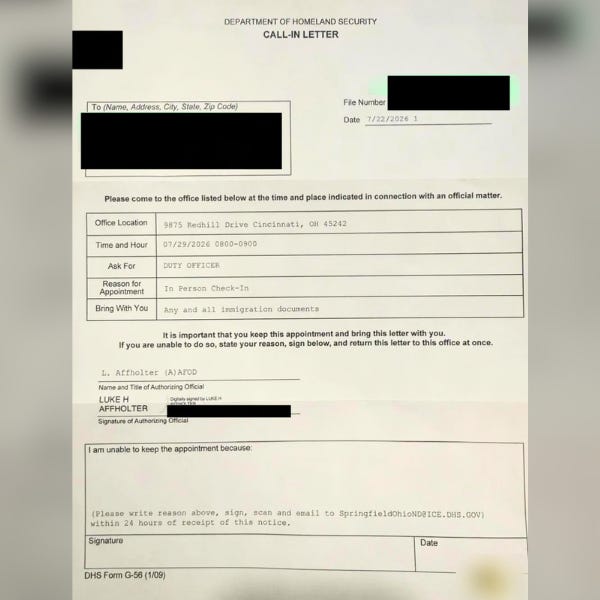
Haitian families who fled a country consumed by violence and natural disaster, built lives here under a humanitarian program that let them live and work legally for years — and then watched that program get eliminated by the Trump administration — opened their mailboxes to a letter ordering them to report to an Immigration and Customs Enforcement field office for a mandatory “in-person check-in.”
The letter doesn’t say anything about leaving the appointment with an ankle bracelet bolted on, reporting their every move from then on out back to ICE.
But that is exactly what has awaited them at these mandatory appointments.
Haitians who show up are being fitted with GPS ankle monitors manufactured and operated by BI Incorporated, a wholly owned subsidiary of GEO Group, the private prison contractor running many of ICE’s detention camps. Then they are sent home, tracked and easy to locate, while the government prepares the infrastructure that may be used to ultimately deport them.
Vilès Dorsainvil, a pastor who runs the Haitian Community Help and Support Center in Springfield, has been fielding panicked calls from families who received the summons. He told the Dayton Daily News that many of his community members had reported receiving letters as of July 31. Some got the notice the same day as their appointment.
“They never used to put a monitor on their leg,” Dorsainvil told the Miami Herald, which first broke the story on July 29.
The question is: why now? And why this way?
The answer, drawn from federal contracts, corporate earnings calls, and independent flight tracking, points to something far larger than Ohio.
It points to a large-scale operation still under construction targeting Haitians who held TPS status — one that uses voluntary compliance to build the tracking infrastructure for a mass deportation that ICE cannot yet carry out.
And one that lines the pockets of corporate executives.
ICE does not have the beds
The population at risk is staggering. Federal records show approximately 352,959 Haitian nationals held Temporary Protected Status until the Trump administration began dismantling the program last November.
On June 25, the Supreme Court slammed the door on any legal challenge. In a 6-3 decision in Mullin v. Doe, the justices ruled that courts have no power to review a TPS termination — meaning the administration could proceed without judges standing in the way.
ICE now has the legal authority to remove roughly a third of a million people — and nowhere near the capacity to hold them.
ICE currently holds about 58,000 people at a time across roughly 225 facilities, according to GEO Group’s own CEO. His company itself runs 23 of those facilities, housing about 21,000 detainees. The administration talks about expanding to 100,000 beds, but that capacity does not exist today.
So ICE, with a new population of over 350,000 targets and no ability to hold them all, seems to be turning to a workaround: catch-and-release under electronic surveillance.
ICE does not have the planes, either
Even if the beds existed, the airlift would fall short by orders of magnitude.
As of June 2026, deportation flights to Haiti were running at a pace of one per month, according to the independent ICE Flight Monitor published by Human Rights First. Each flight carries a tiny fraction of the total population at risk.
On July 21, Jean Négot Bonheur Delva, director general of Haiti’s National Office of Migration, told The Haitian Times that the U.S. Embassy had informed his government to expect two flights per week after July 24, carrying roughly 250 people each. At that rate, Haiti would receive about 1,000 deportees per month.
At that pace, transporting 350,000 people would take nearly 30 years. This means that in order to achieve the Trump Administration’s objectives, ICE must both increase the scale of their air operations dramatically—and have somewhere to detain people in the meantime.
America is in the midst of an increasingly intense civil conflict.
When federal agencies militarize against American cities, when unmarked agents seize citizens in broad daylight, when extremist militias mobilize—the trained analysts and volunteers at the ResistMap National Watchcenter keep the watch, publishing verified incidents & alerts at ResistMap.com.
On this Substack, you’ll find deeper-dive investigations, open source intelligence (OSINT) analysis, notes, and commentary from the expert technologists, former intelligence analysts & emergency managers, and progressive organizers behind America’s first Civil Watch platform.
Please share this post to help keep others informed, subscribe for free to get updates, and if you’re able, contribute to support our vital work.
Port-au-Prince is surrounded by armed gangs and is effectively closed to American aircraft. Flights are landing at Cap-Haïtien International Airport in the north — a facility with limited capacity and, on the ground, almost nothing waiting for the people who step off the plane.
The Haitian government has not announced any national plan to house, employ, or reintegrate returnees. The Ministry for Haitians Living Abroad disclaimed responsibility when reporters called. The National Office of Migration meets each flight alongside the Haitian National Police, hands returnees a transportation allowance — reported by deportees to local media as 10,000 gourdes, about $77 USD — and sends them on their way.
Haiti remains under a State Department “Level 4 — Do Not Travel” advisory. That’s the same rating given to active conflict zones like Ukraine and Sudan. The UN refugee agency maintains an active non-return advisory urging governments to halt forced returns. And the UN’s senior representative in Haiti, briefing the Security Council on July 22, described “persistent insecurity, acute humanitarian needs and institutional challenges” without mentioning deportations at all.
Nothing on the receiving end of this operation is ready for hundreds of thousands of people — the airlift, the landing zones, the nation of Haiti itself. So why would ICE and GEO Group be so in a hurry to act now?
The billion-dollar tracking machine
In September 2025, ICE signed BI Incorporated to a new two-year contract for its flagship electronic monitoring program. The deal covers GPS tracking, phone-based check-ins, and case management for immigrants on the “non-detained” docket — the government’s term for people it wants to deport but does not have room to jail. GEO Group does not disclose the dollar value in its press releases, but federal records confirm the program operates at a massive scale.
On the May 6, 2026 earnings call, CEO George Zoley told analysts that total ISAP enrollment has remained “relatively stable” at approximately 180,000 to 181,000 participants. But within that flat number, the technology shifted dramatically. GPS ankle monitors have climbed to more than 48,000 currently, up from just 17,000 in early 2025. At the same time, participants on the lighter SmartLINK mobile app declined from roughly 159,000 to 131,000.
Same program, same headcount, nearly triple the tracking hardware — tens of thousands of people simply moved deeper into the system, off an app on their phone and onto a device locked around their leg.
Zoley explained the economics plainly: “If this trend continues, the technology and case management mix shift would continue to increase the revenues and earnings generated under the ISAP 5 contract even if overall volume remains constant.”
Strip away the corporate phrasing and the message to Wall Street has been simple: every person with an ankle shackle increases our profits, even without a single new ‘enrollee’, so long as the monitoring keeps getting more invasive.
But now, with a fresh new set of targets in 350,000 Haitians, the profit potential of human suffering is that much higher.
And the room to grow is already on the books: they maintain roughly 100 offices and close to 1,000 employees nationwide under the ISAP contract, which Zoley told analysts is “well positioned to scale up to higher overall counts.”
Put the two numbers side by side — a tracking apparatus built to supervise hundreds of thousands, and a newly deportable population of roughly the same size — and the design gets hard to mistake for coincidence.
The same contractor is also the bounty hunter
The same GEO subsidiary that straps on the ankle monitors also holds a separate ICE contract to hunt down people who disappear. The deal, signed December 16, 2025, is worth up to $121 million over two years — roughly $60 million a year — for what the government calls “skip tracing services for Enforcement and Removal Operations.”
In plain English: bounty hunting by database. BI started the work in March 2026.
On the May earnings call, Zoley acknowledged that the volume was still modest because the government had not yet assigned the next round of work. “We are waiting for them to catch up so we can get our next assignment,” he said.
So the company fitting the monitors is also the company paid to find anyone who slips away — and it works from the same data. Months of location history can put a target’s daily routine on a map before an arrest team ever rolls out.
None of that appears on the letter now sitting in the living rooms of Haitian families across Ohio. The G-56 tells recipients only to “come to the office listed below at the time and place indicated in connection with an official matter,” and stresses how important it is to keep the appointment — nothing about the shackle waiting at the office, and nothing about the contractor on the other end of it.
ICE has outsourced the hardest part of a mass roundup — finding the targets — to the targets themselves.
The deportation pipeline runs through Gitmo
The pieces of the logistics operation already exist, even if they do not yet have the capacity to process hundreds of thousands of people.
Since December 2025, U.S. removal flights to Haiti have followed a fixed route: originating in Alexandria, Louisiana, with a connection in Miami, and making a stop at Guantánamo Bay before landing in Cap-Haïtien. The June 2026 flight — the most recent tracked by independent monitors — marked at least the seventh Haiti removal flight under the second Trump administration to include a Gitmo stop.
And Guantánamo does more on this route than refuel planes. The ICE Flight Monitor counted nine detained migrants held at the base at the end of May, before a domestic shuffle flight on July 1 cleared the population to zero. The base has held Haitian refugees before — most notoriously in the HIV internment camps of the 1990s — and three decades later, the same runway is back in the removal business.
ICE recently announced that they plan to expand detention capacity or build entirely new facilities in the Caribbean, including at Gitmo, in Puerto Rico, and the U.S. Virgin Islands.
These facilities will undoubtedly be used to facilitate the mass deportation of Haitian refugees, and possibly the 1.3 million additional refugees whose TPS status the Supreme Court put at risk in July.
Springfield is just the beginning
The first few people who received those letters and kept their appointments went home that night, back to their families and to jobs that may no longer be legal for them to hold now that their work authorization has expired.
Each of them now wears a device that records every movement, sounds an alert if tampered with, and feeds its data to a company that is separately paid to hunt people down. And tens of thousands more could receive similar letters in the coming days.
Their court dates have been pulled forward, their removal proceedings are accelerating, and the funnel — from voluntary check-in to electronic tracking to Guantánamo to the Cap-Haïtien tarmac — is being prepared.
It works because people are scared. Mail the summons, and let fear do the rest.
When the detention beds are ready, or the logistical capacity expands, or the political moment arrives, ICE will know exactly where to send the trucks.
That is what the monitors are for: the advance work on a mass roundup the government cannot yet carry out, but is working diligently to prepare the logistics for right now.
And the contractor running the system is already telling investors that the more people it puts on ankle bracelets, the more money it makes.
The infrastructure is already built. The only question left is when the government decides to step on the gas pedal.
America is in the midst of an increasingly intense civil conflict.
When federal agencies militarize against American cities, when unmarked agents seize citizens in broad daylight, when extremist militias mobilize—the trained analysts and volunteers at the ResistMap National Watchcenter keep the watch, publishing verified incidents & alerts at ResistMap.com.
On this Substack, you’ll find deeper-dive investigations, open source intelligence (OSINT) analysis, notes, and commentary from the expert technologists, former intelligence analysts & emergency managers, and progressive organizers behind America’s first Civil Watch platform.
Please share this post to help keep others informed, subscribe for free to get updates, and if you’re able, contribute to support our vital work.
I have no words. The fact that this is happening in America is inconceivable and beyond heartbreaking.
ROBERTS RACIST 6. Criminals that will never face justice. There will be deaths and it does not matter to them or MAGAts. Mengele Miller must be ecstatic.